PRESION · Install & Mounting Guide
Put it on right.
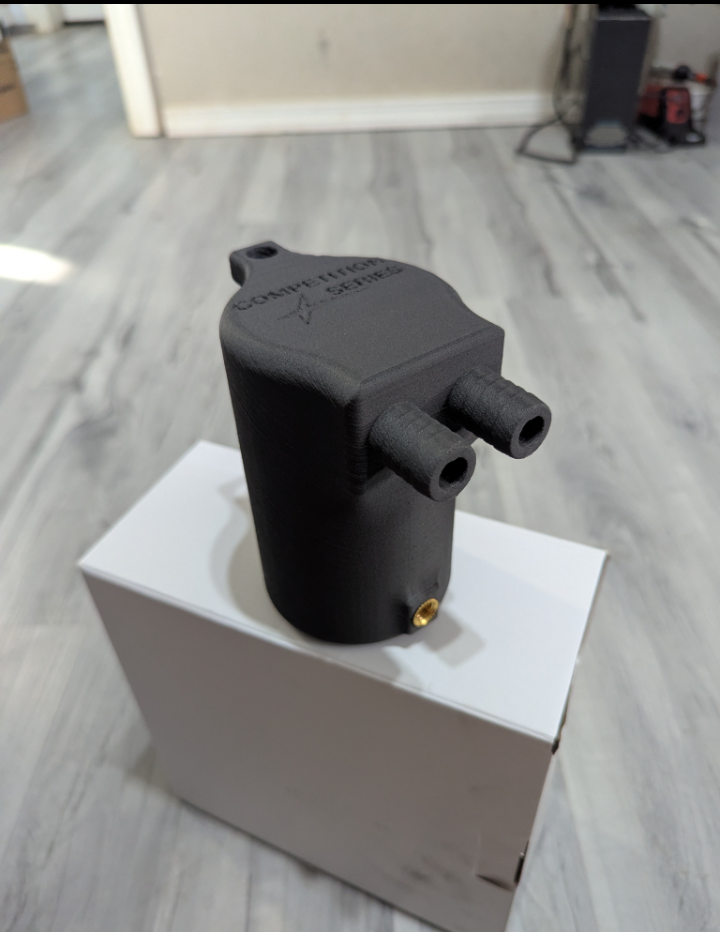
The PRESION is a PA12-CF oil catch can, designed and tested in Austin. It runs closed-loop or open-loop depending on your application. The rules are the same either way: mount it vertical, keep it off exhaust, and drain it before it fills. Read this first. If you still have questions, email us.
1 Where to mount it
The spot comes down to two things: it hangs vertical, and you can reach the drain.
- Mount it vertical, drain at the bottom. The ports are on the side. Oil needs gravity to fall out of the airstream and pool at the bottom; mounted sideways or upside down, it can't separate or drain.
- Good spots: the inner fender, along the firewall area, or any solid point with a sensible, short hose run to your PCV/valve cover and your intake.
- Keep it reachable. You'll be draining this regularly. If you have to pull half the engine bay to reach the drain, pick a different spot.
- Mount to something solid: sheet metal, a strut tower, or a fabricated tab. Bracket it down. Not zip-tied to a hose (we ran it that way on the truck for a year; it worked, and you can still do better).
2 Heat & clearance
PA12-CF is heat-capable, but it is not an exhaust-rated material. Keep it out of direct exhaust and turbo radiant-heat zones.
- Keep it off headers, downpipes, turbo housings, and anything that glows. Radiant heat from a turbo cooks plastic without ever touching it.
- Airflow over it is a bonus, not a requirement: a spot with air moving over it runs cooler.
Don't do this
Don't tuck the can down in the intake-manifold valley like a valve-cover breather perched over the manifold. It's cramped, heat-soaked, and a pain to service.
Rule of thumb: don't mount it anywhere you wouldn't run an intake pipe or other polymer engine-bay parts.
3 Hose routing
Dirty side in
Run from the PCV port / valve-cover (the crankcase side, the source of oily vapor) to the can's INLET.
Clean side out
- Closed loop: from the OUTLET back to the intake (manifold or intake tube), so filtered vapor returns to be burned. This keeps the system sealed and emissions-friendly.
- Open loop / VTA: the OUTLET goes to the breather filter, venting to atmosphere. VTA is off-road use only.
The basics that keep it working
- Keep runs short and direct. Less hose, fewer places for trouble.
- No kinks, no sags. Avoid low spots where oil pools and blocks flow; route so liquid always drains back toward the can.
- Clamp every connection. This is a vacuum/pressure system, so a loose hose is a leak or unmetered air.
- Match the fitting to your hose. Fittings are set up per order: hose barb 1/4"–7/8", AN -3 to -8, with 3/8" barb as the common pick.
4 Service & draining
There's no sight glass on the printed unit, so you set your own interval by watching it early.
- First few hundred miles: check it often. Every fuel fill is a good rhythm. See how fast it fills.
- Then set a personal interval. Once you know your fill rate, you'll know your cadence. A daily driver fills slow; boosted, nitrous, or high-blowby motors fill fast.
- Usable capacity is about 6 fl oz. Always empty it before oil reaches the inlet/baffle level. Once it backs up to the baffles it stops separating and can get pulled into the intake.
- Cleaning is easy. It pulls out in about 5 minutes. Blow it out with an air gun. If you wash it with dish soap, blow it out again afterward and let it dry in a warm, dry environment for 24 hours. PA12-CF is chemical-tolerant.
5 Quick-start install
- Pick a vertical mounting spot with a short hose run and room to reach the drain. Confirm clearance from all exhaust and heat.
- Mount the bracket to something solid. Can vertical, drain at the bottom.
- Identify your dirty source (PCV / valve cover) and your clean destination (intake for closed loop, breather for VTA).
- Cut hose to length for short, kink-free runs. Dirty side to INLET, clean side to OUTLET.
- Push each hose fully onto the barb/fitting, past the barb ridge.
- Clamp every connection.
- Double-check: no kinks, no low spots, nothing touching or near exhaust, drain closed.
- Start the engine, let it idle, check for leaks, and re-check the clamps after the first heat cycle.
6 Care, limits & responsibility
- Fitment is the installer's responsibility. Every engine bay is different. Verify clearance, routing, and that nothing contacts or sits near exhaust before you drive.
- Not for exhaust contact. PA12-CF takes heat but is not an exhaust-rated material. Keep it away from direct exhaust and radiant heat.
- Check it before you drive and keep it drained. An overfull can or a failed hose is yours to catch.
- Open-loop / VTA vents crankcase vapor to atmosphere and may not be street-legal in your area. VTA configurations are sold for off-road use only; check your local emissions laws.
Warranty
10,000 miles against leaks, warping, and cracking. It does not cover heat damage from improper mounting, crash damage, or modified parts. To make a claim, email [email protected].
Don't have a PRESION yet? See specs and order.
Questions before you install? Email [email protected].

Sanchez Performance · Built & tested in Austin, TX · sanchezlabs.us